
What Project Hail Mary Gets Right About the Brain

I loved the movie Project Hail Mary. It was fun, exciting, and truly thought-provoking without a trace of the heavy-handed preachiness that drags down sci-fi movies so often nowadays. I watched the film as a neurosurgeon and writer. So, I wasn’t just following the story—I was completely captivated by how the two characters built a shared language from nothing.

What fascinated me most was their decision to use mathematics as the bridge. A neurological fact most people never consider is that language and math live on entirely separate planets inside the brain.
Two Separate Worlds Inside the Skull
If I were operating to remove a brain tumor, I would have to protect two very different neural networks depending on whether the goal was to preserve speech or the ability to calculate.
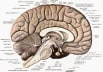
Language is handled primarily in the frontal and temporal lobes on the left side of the brain. One specialized spot organizes the commands to physically produce words (Broca’s), while another area further back decodes their meaning (Wernecke’s). And they’re linked by a high-speed data cable system, exquisitely tuned for grammar, vocabulary, and the rapid back-and-forth of conversation.
Mathematics instructions are mailed in from several completely different zip codes. Advanced calculation lights up both sides of the brain at once. The key player here is a region near the top-back of the head (Intraparietal Sulcus (IPS)) that manages our basic “number sense,” like instantly knowing that five is bigger than three. This network feels much more visual, spatial, and abstract than verbal language.
Because these two systems are so distinct, a stroke can wipe out fluent speech while leaving mathematical reasoning completely untouched. A patient can lose the ability to name everyday objects or form a sentence, yet still solve complex equations. The brain’s internal dividing lines are that precise.
Building a Bridge with the Wrong Tools?
This separation makes the first-contact problem in the movie especially interesting. The human and the alien have incompatible bodies. Neither can physically produce the other’s sounds. The human cannot project musical alien chords, and the alien cannot mimic human vocalizations. There is no shared starting point.
So they don’t start with language at all. They start with numbers, geometry, and the universal constants of physics.
From a brain-science point of view, this is a remarkably clever workaround. They are using the math network—the one that appears more universal and less dependent on any particular biology—to create a temporary scaffold that can eventually build a bridge to the language network. The characters recognize patterns through their number centers, then slowly map those patterns onto concepts their communication systems can begin to process. It is, in effect, the ultimate neural crossover: using one brain system to kickstart another.
The Fiction vs. The Friction
As someone who studies how the brain adapts and rewires itself, I have to admit the movie takes some generous Hollywood liberties with the speed of this process. In the story, a laptop program quickly pairs alien sounds with English words and establishes fluent communication within weeks.
In reality, adult brains do not change that fast. An alien mind would almost certainly experience time, memory, and existence in ways that have no direct counterpart in human thought. Translating those alien concepts into the language structure we rely on would require painstaking trial and error—likely measured in years, not weeks. The brain’s ability to adapt has limits, especially when the starting point is something completely alien.
Still, I’m happy to set aside strict realism. The deeper message of the film is what stays with me. Even when two minds begin with completely incompatible communication systems, the brain retains a remarkable capacity to find overlapping patterns and build new pathways. The story reminds us that whether we are studying brain scans or looking out at the stars, the universe appears to be built on structures that patient, creative minds can eventually learn to share.
That, more than any single plot twist, is what made Project Hail Mary linger for me long after the credits rolled. It is ultimately a story about the stubborn, hopeful flexibility of intelligence itself—whether that intelligence evolved on Earth or somewhere far beyond it.
I've been fascinated by brain workings for awhile so appreciate the discussion! I read Broca's Brain years ago, and enjoyed Carl Sagan's take on things. I work in long term care in respiratory and brain function always overlaps the care, to say the least!
My wife and I just saw the movie as well and it was interesting where they took things. I surely agree on that learning curve!
Wow, the math regions with their spatial, visual and abstract abilities really seem to show up as players in the communication business. It makes me wonder then if speech is damaged, that word processing, yet the math side has understanding, just not a vehicle to express?
Super thought provoking, Dr. Marc and enjoy every insight!